
 ⤢ View photo
About this place
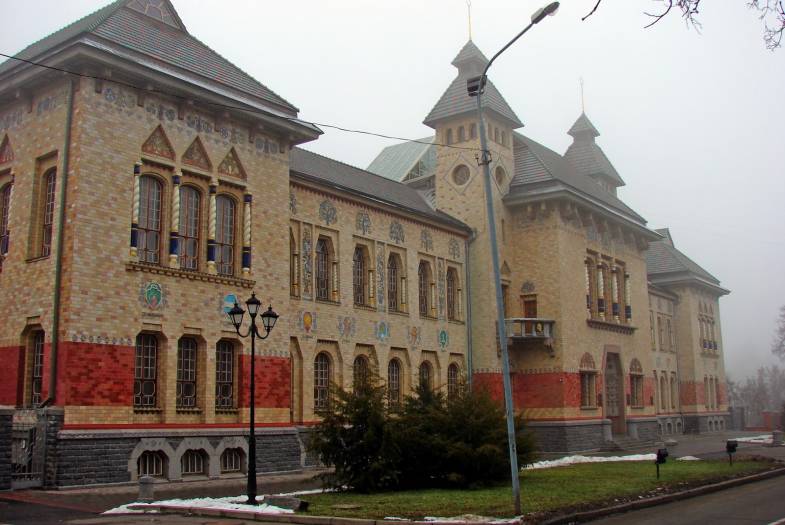
Poltava Local History Museum is among the oldest museums in Ukraine. The museum was founded by Professor Vasyl Dokuchaiev. He instructed architect V. Krychevskyi to create the project. The museum was built in the Art Nouveau style. It is a very beautiful and unique building. It is impossible to pass by without looking at it. The exterior of the building resembles Ukrainian dress. The central entrance to the museum is decorated with red tiles, symbolically recalling a belt. A belt in Ukrainian clothing was an integral part of dress and was almost always red. This is what V. Krychevskyi wanted to emphasize in the decoration. During the Second World War, the building's decoration was badly damaged. But the destroyed decoration was restored to its original form in the 60 -s of the 20th century.
For the museum's decoration, V. Krychevskyi collected ornaments from all regions of Ukraine. He redrew them from jugs, towels and other household items. He modernized them and transferred them to tiles and paintings. He was helped in this by the Opishnia masters. The most common motif in the paintings is the tree of life. It is a symbol of infinity and the connection of the three worlds. At first, only the third floor of the building served as the Poltava Local History Museum. There was a collection of natural history art here. This is the very first collection, which began to take shape more than 130 years ago. The very first exhibits were soil samples and herbariums. Today this department contains more than 300 thousand exhibits.
The nature department currently features exhibits of various species of animals and birds. There is also a life-size mammoth monument, which lived on the territory of Poltava region before AD. The department presents the flora and fauna of Poltava region.
The Poltava Local History Museum contains monuments of historical culture - idols and stone sculptures. Four of them have survived to the present day. In the hall of the Cossack era there is a life-size knight's armor. Its weight is about 30 kg. It was with such knights that the ancient unprotected Cossacks had to fight. This hall contains many objects from the Cossack era. The local history museum houses a unique exhibit - an 18th-century bell made from a cannon. It bears inscriptions. This is a poem that tells about the Cossack campaigns of that time. Another unique exhibit in the museum is a canvas by Myasoyedov, which initially served as a backdrop in a theater. But later it was transferred to the museum. Of course, the local history museum of Poltava has many exhibits devoted to M. Hohol, an outstanding writer from Poltava region.
The Chumak period is presented in detail. The museum displays various kinds of embroidery. But the main exhibits are varieties of Poltava embroidery. The Poltava Museum contains a hall that once served for meetings of the provincial zemstvo. It was built in a church style and has a balcony where the press was located during zemstvo meetings. The walls are decorated with three panels that tell about three stages of life in the 18th century - political, economic and military.
There is a section on Poltava life. It presents a complete interior of a Ukrainian house. The exhibits include a weaving loom, a stove bench, a pipe, dishes, and benches. A special place was given to the pokutia, where icons were kept. The pottery section features Opishnia-made items - kumantsi, jugs, etc. The weaving section includes more than one hundred varieties of carpets, varieties of plakhtas, and towels.
A new exhibition called “Treasury” has been created in the Poltava Museum. It contains exhibits from other cultures and has been assembled from all over the world. Unique objects from ancient Roman, Greek and Egyptian cultures are preserved here.
The museum itself is a real treasure. It contains many unique and inimitable exhibits. It takes more than an hour to get acquainted with everything. Therefore, if you plan to visit the local history museum of Poltava, allow at least a couple of hours.
As of today, the museum staff are collecting and opening a new hall dedicated to Russia's invasion of Ukraine in 2022.
Reviews (0)
No reviews yet. Would you like to leave the first review?


